How is AI changing the way consumers shop online?
You’ve optimised your Shopify store for human visitors, now it’s time to do the same for AI agents.
The AI era is officially here, with AI now impacting many areas of our work and home lives, including the way we shop online.
For the last 20 years, SEO has been all about helping humans find your store using search engines like Google. In 2026, that’s all set to change as more and more people begin using AI agents to find, compare, and buy products online.
An article published by the BBC in December 2025 highlighted how many people used AI tools to help them discover products, compare prices, and even complete purchases over the Christmas period last year.
If you manage a Shopify store, optimising it for agentic search (that’s AI agents and chatbots) is the next step you need to take to maintain visibility and stay competitive in the fast-moving AI era.
In this article, we’ll explain what a Shopify Agentic Storefront is, how agentic search works, and what you need to do to ensure your store can be read by AI-powered tools and is visible to the next generation of shoppers.
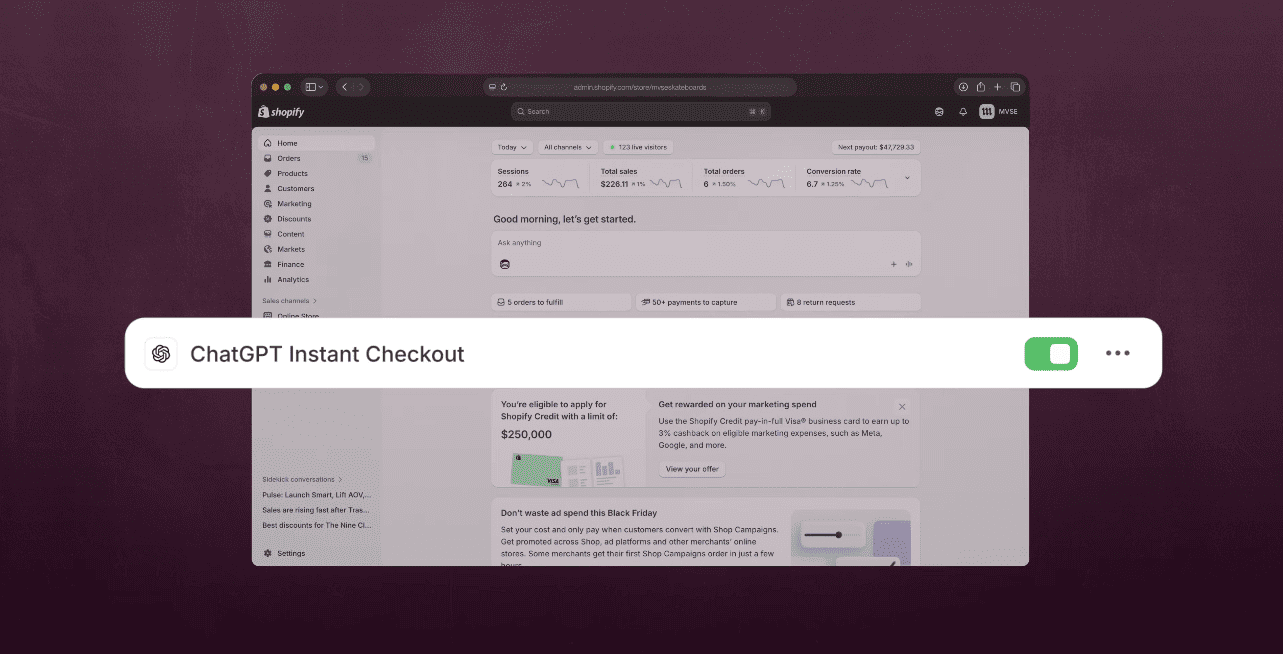
Screenshot from Shopify’s “Agentic Storefronts: Reach buyers in AI chat platforms” video on YouTube
What is a Shopify Agentic Storefront?
Shopify Agentic Storefronts were launched as part of Shopify’s Winter ’26 Edition – “The RenAIssance Edition”.
The update explains that Shopify Agentic Storefronts can be used to manage how your brand appears to consumers who use AI to shop, helping them discover your products directly within AI tools such as ChatGPT Shopping, Copilot, and Perplexity.
Shopify Agentic Storefronts are not visual sales channels; they are headless interface layers designed for AI machines. They provide AI assistants with structured data, logic, and API hooks that make your product catalogue easily readable for AI agents.
eCommerce brands that use Shopify Agentic Storefronts will gain greater product visibility among shoppers using AI-powered agents to browse and buy.

Image Credit: Instant.so
What does the agentic shopping journey look like?
If you’ve never used AI to help you discover or purchase a product, you might be wondering how it actually works.
Agentic shopping is designed to save time and make it much easier for shoppers to find exactly what they’re looking for. Instead of jumping between multiple websites, comparing products and reading reviews, the whole shopping journey happens inside the AI tool.
Here’s a quick rundown of how it works:
Step 1: The shopper asks their AI assistant to find a product for them.
The request can be very specific, for example, the user could ask the AI agent to “find a non-toxic, machine-washable cat bed priced at £30 or less and measuring no more than one metre squared.”
Step 2: The AI agent searches and compares products.
It very quickly scans a huge number of stores, analysing product data, availability, pricing, and reviews. It may also factor in past preferences and prioritise stores that offer fast delivery or a good returns policy in its results.
Step 3: The AI agent creates a shortlist of products.
The AI agent presents the user with a shortlist of the most suitable products for them to choose from.
Step 4: The purchase is completed.
The user confirms which item they want to buy, and the AI agent adds it to their basket on the retailer’s website and completes the purchase autonomously.
Will Shopify Agentic Storefronts replace traditional storefronts?
In short, no, that is not something that we see happening any time soon. A Shopify Agentic Storefront does not replace or compete with your traditional storefront. Instead, it acts as the connective tissue between your Shopify data and AI agents. Your Shopify Agentic Storefront operates parallel to your traditional storefront, sitting alongside your store’s theme, apps, and APIs in the tech stack.
How do Shopify agentic storefronts and traditional ecommerce storefronts differ?
These two separate storefronts cater to different audiences – one is for humans, and the other is for robots – so they are designed to meet different needs. Your traditional storefront is very visual. Shopify web design, imagery, layout, and colours play a huge part in grabbing your audience’s attention and gaining their trust. In comparison, your agentic storefront prioritises structured data and logic to make it easily readable for machines.
What is data UX?
In the past, user experience (UX) has been all about how a human interacts with and experiences your website – including its layout, imagery, navigation, and design. In the AI era, the user isn’t always human – it could be an AI agent.
That’s where data UX comes in. Data UX concentrates on using data to make your products, policies, and promises easy for a machine to locate, read, and understand.
How to optimise for agentic search using data UX
Optimising your Shopify store for agentic search revolves around ensuring your store’s data is clear and organised. To make your products visible to AI agents, you should prioritise clear taxonomies, unambiguous attributes, and rich, structured metadata.
Let’s explore the three pillars of optimising data UX for agentic search:
1. Build your Shopify Knowledge Base
Shopify has introduced a new Shopify Knowledge Base app that allows brands to upload clear information about their return policies, size guides, sustainability promises, and more. Data in the Knowledge Base is clearly structured to make it readable for AI agents.
2. Standardise product taxonomy
To understand what kind of products you’re selling, AI agents need access to clear, standardised product taxonomies. Make sure that your product taxonomy matches Global Product Classification (GPC) standards and use metafields to define specific attributes like material, origin, care instructions, and dimensions.
3. Enable “transaction hooks”
Before AI agents can add items to the cart on your website autonomously, you need to permit them to do so. Check that your Shopify store has the latest Cart API permissions enabled to authorise agents to make purchases on your website on behalf of their users.
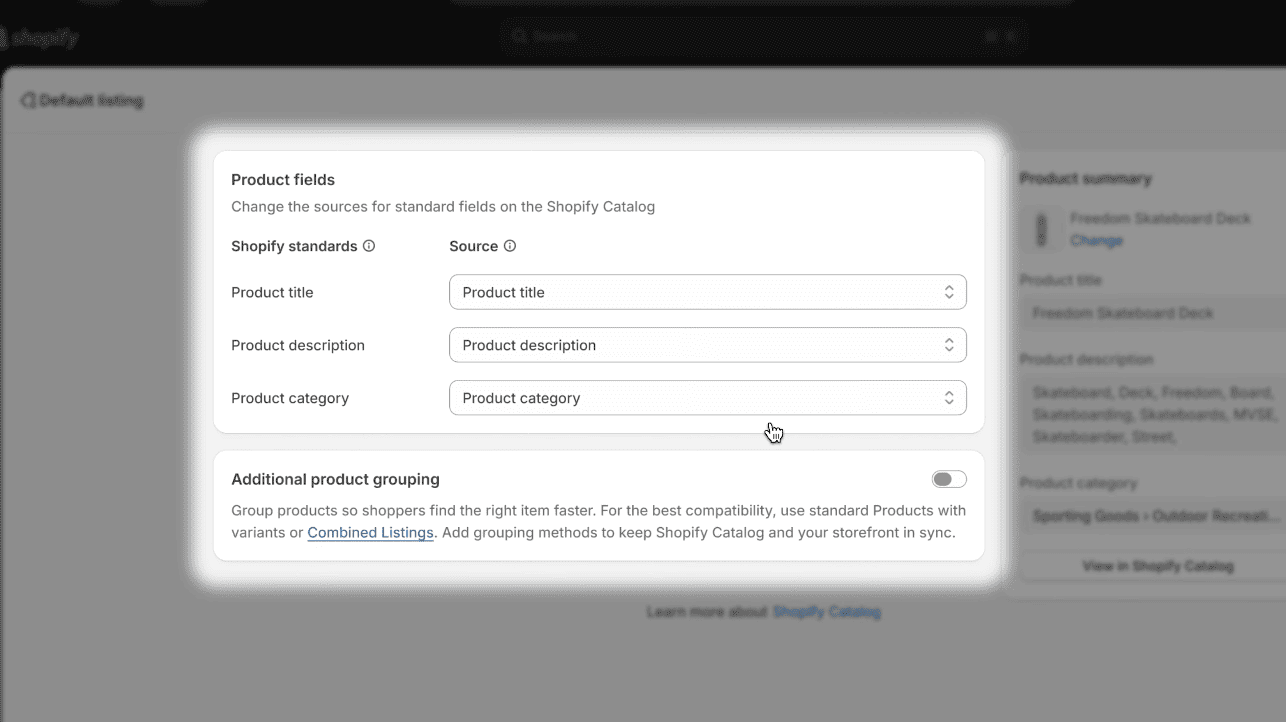
Screenshot from Shopify’s “Agentic Storefronts: Reach buyers in AI chat platforms” video on YouTube
What are the key requirements for AI-first store design?
As the way consumers shop online evolves, so must the way we design eCommerce stores. To stay competitive, Shopify stores now need to do more than look good to human shoppers; they also need to be well structured and easy to read for machines.
Let’s look at some of the most important design features for Shopify stores in the AI era.
- Structured data: Present all data in a machine-readable format.
- Standardised taxonomies: Use standardised and consistent category names, product tags, and filter logic.
- Fast loading speeds: Make sure your store loads quickly – AI agents won’t wait if it takes too long.
- Trust signals: Display verified reviews, badges, and certifications.
- Real-time inventory: Keep stock levels and availability updated in real-time using an API.
- Transparent policies and buyer promises: Use structured data like the Shopify Knowledge Base app to clearly display delivery times and return policies.
- AI-optimised checkout flow: Streamline and optimise your checkout flow using Shopify’s native or headless checkout.
Partner with Create8 for help adding an agentic storefront to your Shopify store
Are you ready to welcome the next generation of shoppers to your store?
Get set up with a Shopify Agentic Storefront to futureproof your store and avoid getting left behind in the AI era.
At Create8, we’re proud to be a Shopify partner. Our team of Shopify experts and developers are here to help you take the next step in your eCommerce journey. For tailored support and advice with optimising your Shopify store for AI, contact our team by calling 0161 820 9686 or filling out a contact form online.
Shopify Agentic Storefront FAQs
Why do I need to optimise my Shopify store for AI agents?
As more and more people begin using AI agents to help them shop online, optimising your store to ensure your products are visible and purchasable through these tools is key to staying competitive.
Will adding an Agentic Storefront affect how my store looks for human customers?
No. Agentic Storefronts run in the background. Adding one to your Shopify store will not change how your store looks for humans.
Will optimising my store for AI agents affect my SEO?
Yes, optimising your store for AI will actually help to boost SEO! Structured data used for AI optimisation also improves search visibility.
How do AI agents decide which products to recommend to users?
AI agents prioritise products based on a variety of factors, including structured data, availability, pricing, delivery options, trust signals, and user preferences.
Do I need a developer to add an Agentic Storefront to my Shopify Store?
In most cases, yes. Setting up structured data, enabling real-time inventory, and configuring Shopify’s APIs is usually a job for a developer – contact our team of Shopify experts if you need help.
“We’re already helping Shopify brands prepare for agentic commerce by structuring their stores so AI agents can properly understand, compare, and purchase their products. At Create8, this isn’t just theory, it’s becoming part of how we build and optimise stores for growth. Brands that invest now in clean product data, strong store architecture, and AI-ready storefronts will win more visibility, more recommendations, and ultimately more revenue as AI shopping becomes mainstream.”
— Keaton Vernon, Shopify Developer at Create8