If you’re still structuring your B2B landing pages the same way that you did 10 years ago, you could be putting modern buyers off.
In 2026, asking visitors to call or fill out a form to request a price list is a big no-no.
Today’s generation of B2B buyers is more digitally-savvy than ever before. Many of them don’t remember life before the internet and expect fast and frictionless services.
If you want to capture their custom, you’ll need to change your approach to landing page design.
In this article, we explain how outdated B2B landing pages could be killing your conversion rates, and what you should be doing to fix them.
The psychology of the new B2B buyer
Today, your average B2B buyer is a 35-year-old digital native, and the old “contact us for a pricing list” button won’t cut it with this generation.
Understanding your audience is an essential part of conversion rate optimisation (CRO), so let’s find out more about what makes today’s B2B buyers tick.
Millennials and Gen Z (that’s people born from 1981 onwards) now make up the majority of B2B buyers. And these younger generations despise lengthy or inefficient processes, “gatekeeping”, and being made to wait.
They carry out research on their phones, use AI to compare vendors, and when it’s time to buy, they want to buy now and receive the item quickly – they’re impatient and value fast and responsive buying experiences.
If your landing page creates friction that stops the user from achieving their goal quickly, this generation will quickly lose patience and look for a competitor offering a faster service.
Here are some key traits and behaviours of modern B2B buyers in 2026:
- They prefer a rep-free, self-service experience: Research by Gartner shows that 75% of B2B buyers now prefer a rep-free, self-service sales experience.
- They prioritise speed: If they can buy a mattress on Instagram in 30 seconds, they won’t wait 48 hours to receive your wholesale quote.
- They ask AI for advice: While they’re not keen on hearing what your rep has to say, they use AI tools like Sidekick and Perplexity to help them identify the best business to work with, so your landing pages need to be easy for both humans and machines to read.
- They expect a B2C-level user experience: In practice, this means:
- Fast-loading pages.
- Clear transparent pricing.
- A fast and simple checkout process.
- Minimal friction.
Rather than being sold to by a sales rep, today’s B2B buyers want to do their own research. They are more risk-aware and will take time to compare and verify everything independently, often using AI to help speed the process up. Your landing page should be designed to enable that, not slow it down.
What makes a good B2B landing page in 2026?
Ready to start building B2B landing pages that generate more leads? Modern B2B buyers expect fast, low-friction experiences, meaning the top converting landing pages look a little different today than they did a decade ago.
The Hero section
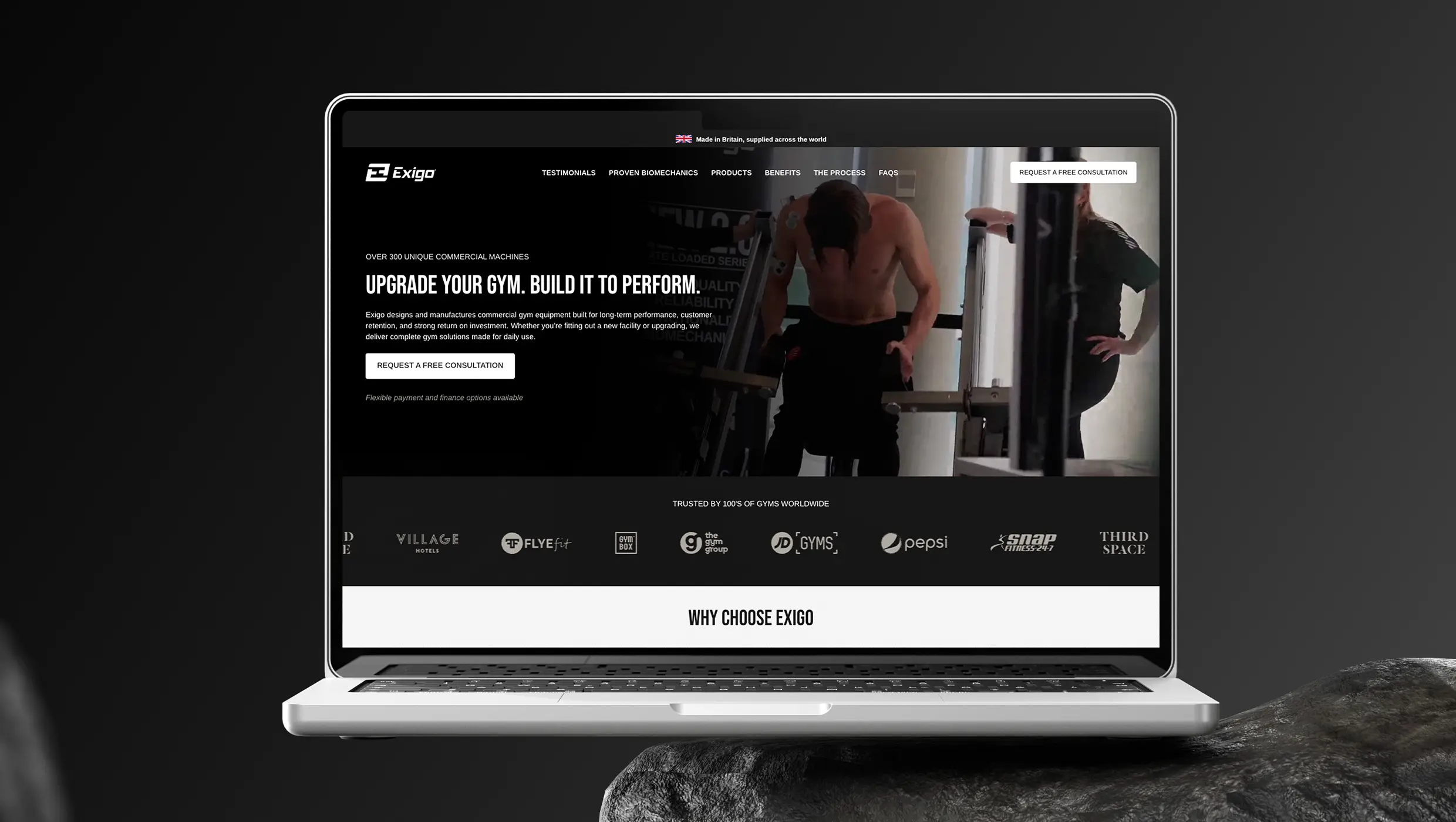
The hero section is the information located above the fold, making it the first thing visitors see when they land on your page. It needs to grab your audience’s attention and encourage them to keep reading.
This section typically consists of:
- Headline
- Supporting text
- Image
- Call-to-action
Headline and supporting text
Use this section to tell your customers what your product can do for them in as few words as possible. You want it to be crystal clear what value you’re offering. That means no jargon or waffling.
Instead of vague corporate waffle like: “Synergistic solutions for enterprise logistics”. Tell your audience clearly what it is you do and how you can help them.
That could look something like: “Cut your shipping costs by 18% with our automated freight audit.”
This version provides instant clarity – no decoding required, making it more attractive to time-starved modern B2B shoppers.
Imagery
When choosing the imagery for your B2B landing page, avoid generic stock imagery at all costs; it can look unprofessional and impersonal.
Modern buyers want to see real imagery of what you’re offering and proof of its value. Show them your software’s interface, dashboard analytics, or your product being used in a real-world setting.
Call-to-action
When creating a CTA for your page, don’t forget that not everyone who lands on your page will be at the same stage of their journey, so don’t try to force them all down the same funnel.
Instead, split the funnel into two different CTAs. This could look like:
- Primary CTA: ‘View wholesale pricing’
- Secondary CTA: ‘Book a 15-minute demo’
This approach gives buyers more control and helps to reduce friction.
Trust bar
And finally, the trust bar. Modern buyers don’t want you to tell them how good your service or products are. They want to see proof of their value from real customers.
When done properly, this section can be extremely persuasive, helping you to build credibility and gain your audience’s trust.
So what should your trust bar look like in 2026?
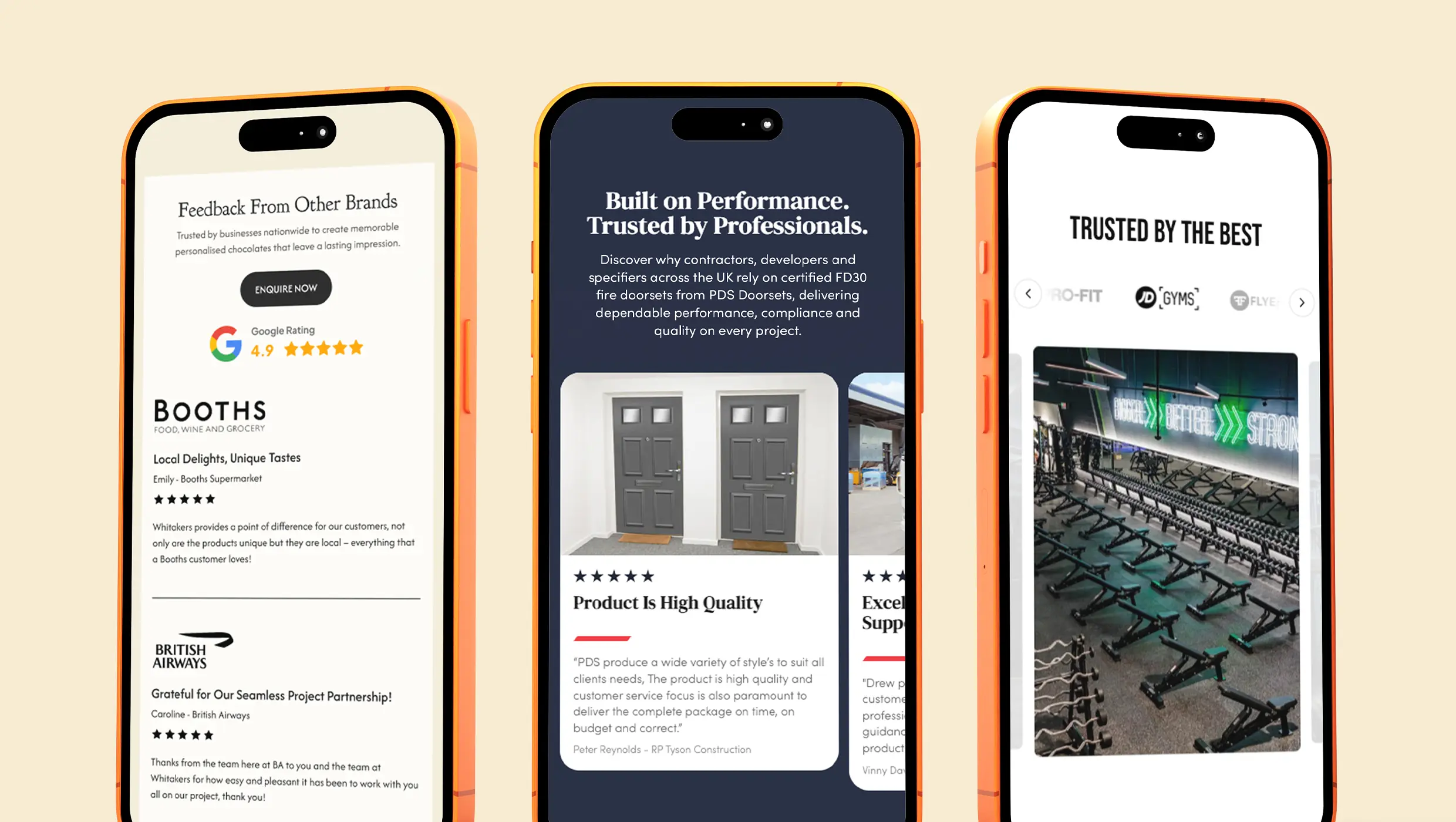
Swap that giant wall of logos (for each business you’ve worked with) for real customer reviews and case studies that demonstrate the measurable outcomes achieved using your products or services.
Integrating reviews from third-party platforms like G2, Trustpilot, and Capterra can also make this section of your page feel more authentic and less controlled.
The more credibility you can demonstrate, the more reassured your audience will feel, lowering the perceived risk, and helping to speed up buying decisions.
Capturing leads without form friction
The B2B buying cycle is notoriously long, so chances are visitors aren’t going to make a purchase the first time they land on your page. That’s why capturing leads is so important in B2B. It gives you a way to contact these people again, before they disappear into the ether forever.
So, how can you get all the information you need, without scaring off your visitors?
Every field you add to your form increases friction and reduces the chances of conversion, so you need to keep it as simple as possible.
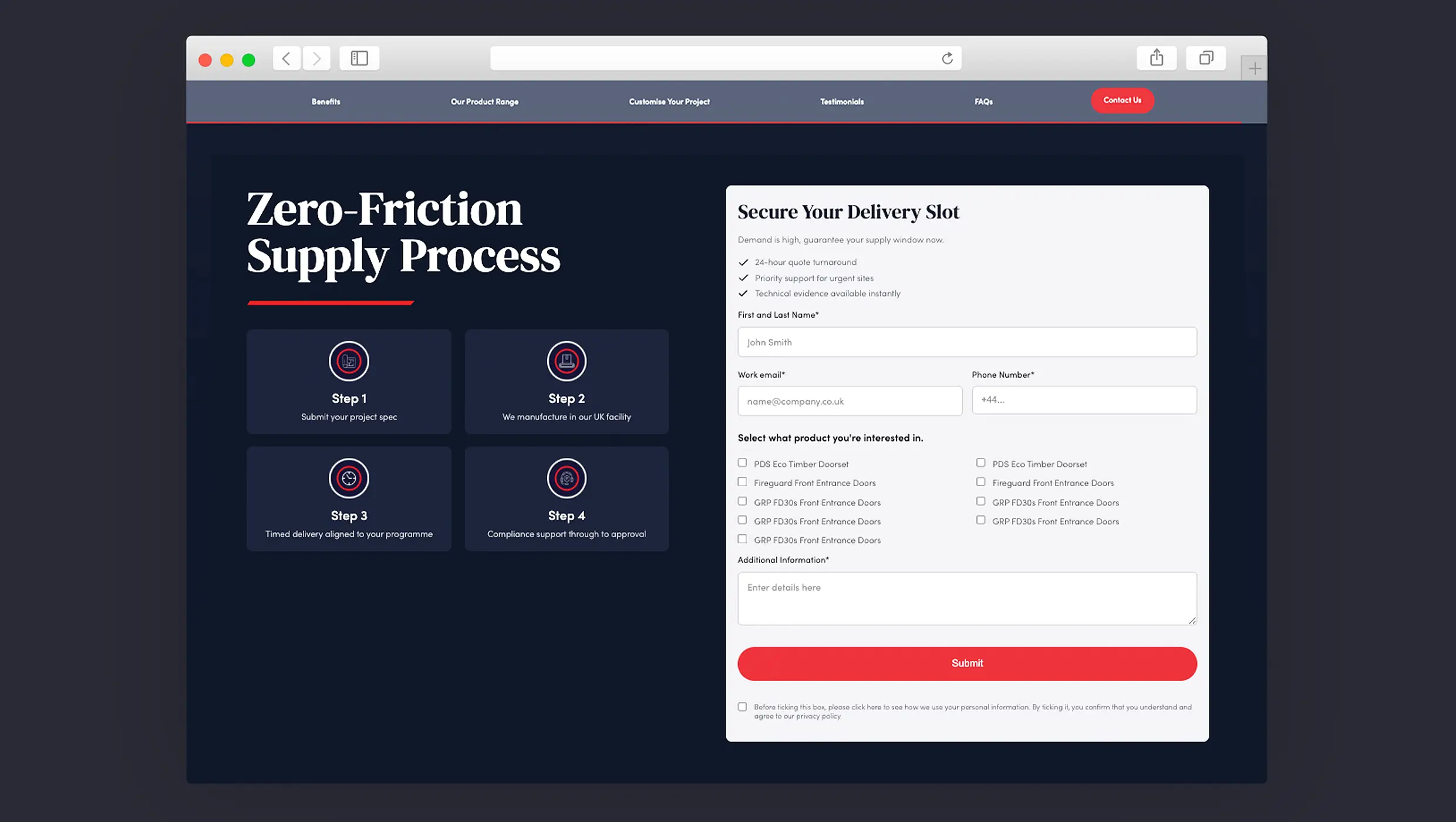
There are two main strategies for getting the information you need without asking your customers for anything more than their email address. These are:
Data enrichment tools
Data enrichment tools like ZoomInfo and HubSpot’s Clearbit use APIs to connect to your database or CRM.
When using one of these tools, the only field you need to ask visitors for on your landing page is their email address. The software then recognises their email’s domain and scans third-party databases to populate the empty fields, like company size, revenue, and industry.
Progressive profiling
Progressive profiling is a strategy where, instead of asking for all the information you need in one go, you gather it gradually over multiple interactions.
So on the B2B landing page, you only ask for an email address. But then on the thank you page, you may say something like “One more question to help customise your demo: How many employees does your business have?”
This way, you’ve already got the lead, even if that second question turns out to be one question too many!
What types of lead magnets convert best in 2026?
Your lead magnet is the carrot you dangle in front of your visitors to persuade them to hand over their email address to you.
And in 2026, another downloadable PDF whitepaper probably isn’t going to cut it.
To attract more interest, you need to offer something that provides instant value – extra points if it’s personalised!
The lead magnets converting best right now are interactive calculators and tools that give users instant answers tailored to their circumstances. For example, an ROI calculator that visitors can use to input their current spend and find out exactly how much they could save by using your product or service.
Original research and data reports are also very effective. For example, you could offer a report about the current state of the industry, containing useful data gathered by surveying industry leaders. This is not only very valuable to your audience, but also positions your business as an authority within the industry.
Using Shopify Plus for B2B success in 2026
If you’ve built your eCommerce empire using Shopify, this gives you a distinct advantage in 2026!
Shopify Plus offers several advanced B2B tools that can help you create a faster, more modern buying experience for today’s generation of B2B shoppers.
Let’s find out more about two of Shopify Plus’s most popular B2B features in 2026: blended storefronts and quick order forms.
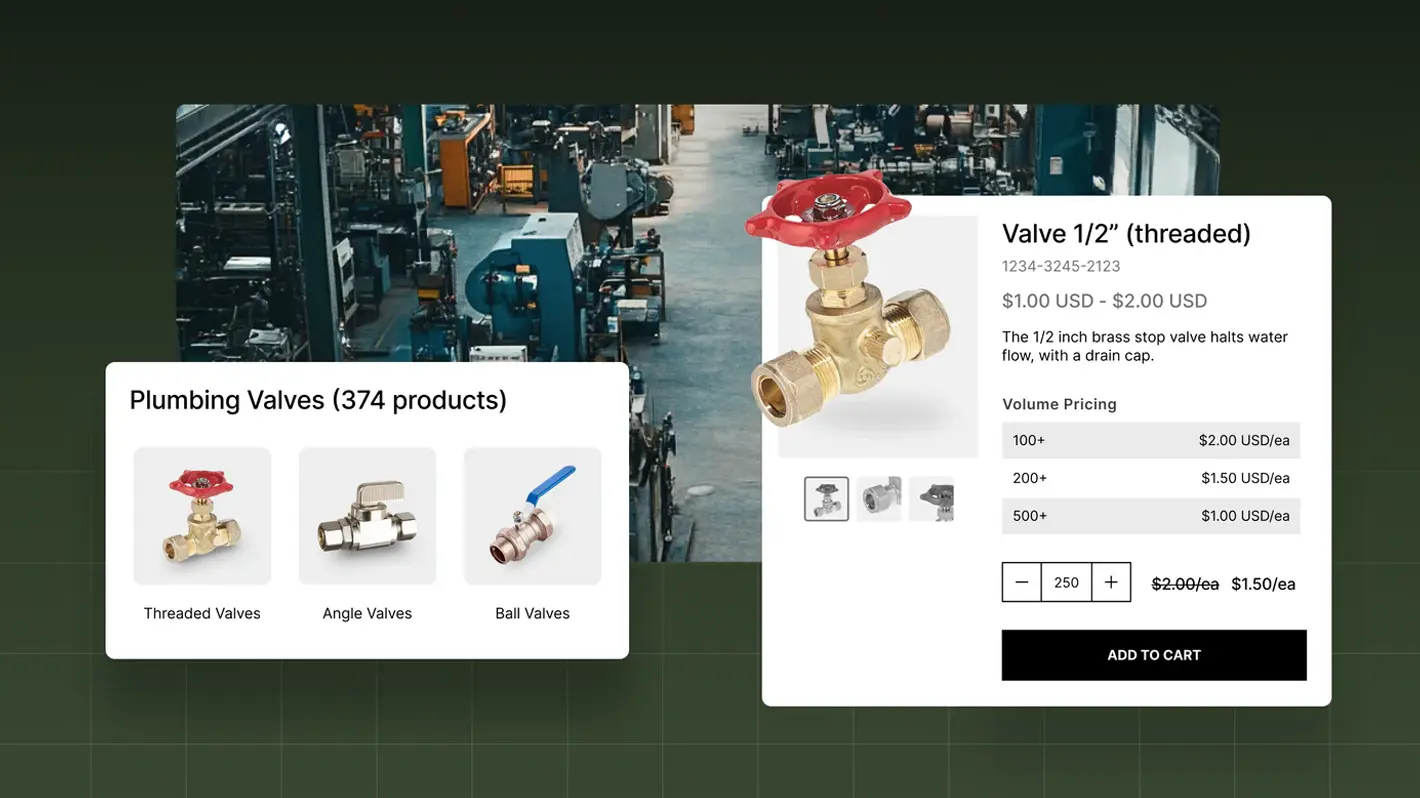
Image Credit: B2B on Shopify
Blended storefronts
Traditionally, many businesses operate two separate eCommerce stores side-by-side – one for B2B customers and one for B2C customers.
This approach can create a disjointed user experience, as well as being complicated and time-consuming to manage.
Shopify Plus enables brands to create blended storefronts, using Shopify Contexts. A blended store allows customers to choose whether they want to view the B2B or D2C version of a store and enables instant purchasing without a sales rep.
For example, a B2C visitor may see a product priced at £100, whereas a B2C customer can log into the same website as a wholesale customer to see the same product priced at £60 with ‘net 30’ payment terms available.
This helps businesses to create a lower-friction, self-service B2B shopping experience while still protecting trade-only prices from public visitors.
Quick order forms
Returning B2B customers want to be able to place a bulk order quickly without having to navigate through multiple product pages.
Often, they already know which products and how many units they want to order.
Shopify Plus’s quick order forms allow B2B customers to search SKUs and enter quantities quickly to add multiple products to their cart at once.
For repeat customers, this can dramatically reduce friction and speed up the buying process, which is exactly what modern B2B buyers are looking for.
Quick order forms can even be embedded directly onto landing pages designed for repeat ordering campaigns to make reordering even more effortless.
Optimise your B2B landing pages with Create8
If your B2B landing pages are still built around outdated buying behaviours, you could be losing valuable leads.
At Create8, we help brands create modern, conversion-focused landing pages designed around the needs of the new generation of B2B buyers.
Contact us today to discover how we can help your business increase conversions, reduce friction, and generate more qualified leads from your landing pages.